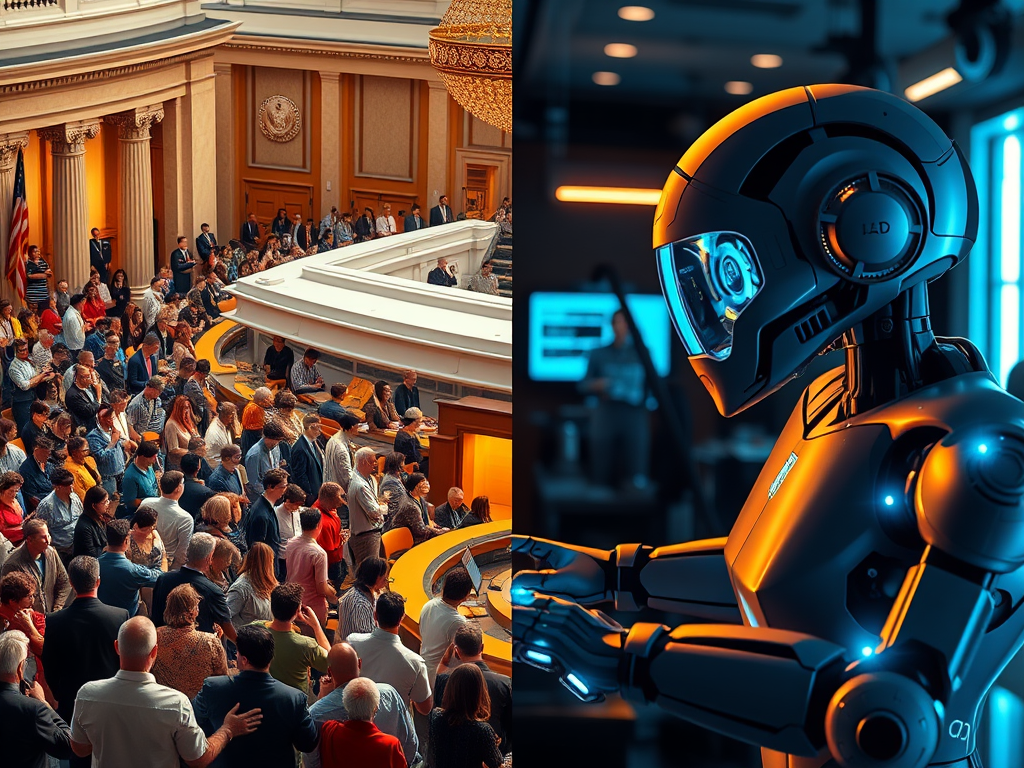
My focus this week is looking at how our governance and government is adapting to the emerging world of AI and the growth of life sciences.
Microchipping Humans
One of the most interesting state legislative trends I stumbled over is a report by the Carnegie Council for Ethics in International Affairs entitled “The rise of Preemptive Bans on Human Microchip Implants.” Thirteen states have enacted laws (with others in consideration) to prevent companies from requiring employees to accept a surgically-inserted microchip.

Where did this even come from?
It seems that internationally this is indeed a thing. It is voluntary but employees use the chips swipe keys, credit cards, share social media, gym entry, and access to e-tickets. They are most commonly used in Sweden.
While they are not in the states yet, the laws represent proactive action on the part of states given the speed of technology innovation and adaptation.
Building AI Leadership
Not surprising, Directors of AI in local political structures, media and businesses are mushrooming across states and cities. The point of these positions is to develop policy, oversight and governance, collaboration, public engagement, developing initiatives and risk management. New York has an AI Czar. So does the New York Times.
Addressing Social Challenges
This one surprised me but also gave me hope. Family Promise in Pierce County, applies AI tools to help manage homelessness. The AI-system supports people by assessing their needs, then connecting them to resources available to them. The County has an intake-system that runs into bottlenecks, and this adds to their capacity.
Los Angeles County partnered with UCLA to create an algorithm to predict homelessness, with the goal of enrolling those at risk in early interventions before they are on the streets.
I got these two examples form the article “Can AI Support Good Government? Some Pilot Programs Suggest Yes”. Take a look as there are more examples.
The more I delve into this subject the more questions I have.
Is privacy gone? AI knows a lot about us. Does it matter?
Do we need government or do we need to think differently about governance? This last question, I plan explore through this blog.
Here is what I see.
We are not global but planetary and yet we watching the global system split into new and potentially more aggressive factions. Will Nato hold?
Will there be enough work? If not, are there are other ways to structure the world, ways that allow us to focus differently in our relations to each other, to resources, to nature, and to humans living in distant physical places but are neighbors in cyberspace?
Thoughts welcome.
Images generated by AI.
 Shari Garmise
Leave a comment